
The Market Has Changed - Buyer Expectations Haven’t
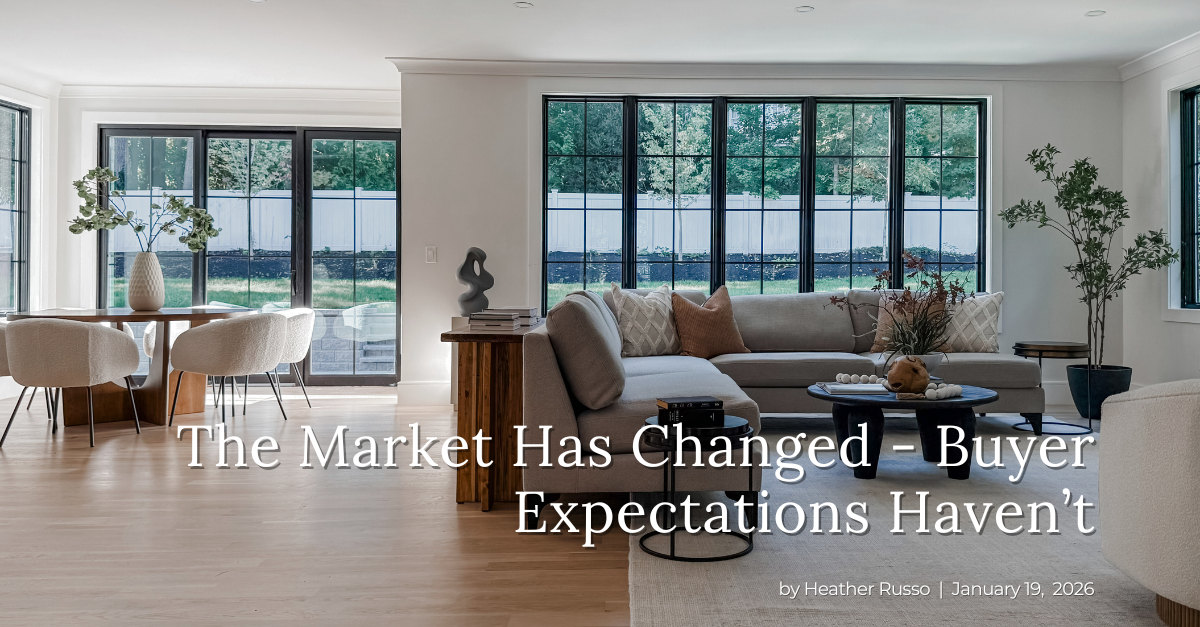
As we settle into 2026, I’ve seen no shortage of predictions about what this year will bring for the real estate market. They’re all grounded in logical analysis - past cycles, current inventory levels, buyer behavior - which, in many ways, is both smart and insightful.
By most objective measures, we’re operating in a more normal, balanced market than we’ve seen in years. Inventory is healthier. Buyers who pressed pause in 2025 are re-engaging. The activity is real and the spring real estate market in Boston, as it typically does, swung into full gear on January 2nd.
But markets aren’t driven by logic alone. Both buyers and sellers are, first and foremost, human - and humans respond emotionally to the broader conditions around them. And while the real estate market may be normalizing, the world around it is not. We are all living in a moment defined by volatility, uncertainty, and rapid change - conditions that inevitably shape how people perceive risk, value, and timing.
And amidst what can only be described as a chaos-infused market normalization, we’re seeing interesting shifts in both buyer and seller psychology - particularly at higher price points - and some are more predictable than others.
Firstly, with more homes to choose from, buyers now have leverage. And when buyers have leverage, they become more discerning - and far more comfortable negotiating on price. And when sellers aren’t ready to adjust pricing to reflect current conditions, but buyers are no longer willing to pay last year’s numbers, homes linger.
That tension creates a real challenge. For sellers, adjusting price can feel like an immediate loss - even though the price they expected six months ago was never guaranteed. The market that exists today, not the one we anticipated, always sets value.
So instead of recalibrating price expectations, many sellers and agents look for ways to reduce upfront costs. And staging is one of the first (and most visible) places where changing market conditions make themselves felt.
On the surface, this feels reasonable. If the market isn’t moving at the same speed it once did, why invest more?
But in practice, this is where value begins to erode - quietly, unintentionally, and often quickly.
And this is where the cycle becomes self-fulfilling - because sellers will never have more leverage than they do in the first few weeks a property is on the market. Elevated pricing paired with reduced presentation in a moment of increased buyer leverage rarely creates momentum - it creates price reductions.
Cost-Cutting vs. Value Protection
At higher price points, staging’s primary purpose isn’t decoration, demonstrating functionality, or even simply increasing perceived value - it’s about reinforcing, supporting, and justifying the listing price.
At this level, staging becomes an insurance policy - one that protects both pricing and value.
Yet we’re currently seeing beautifully built, well-located homes undermined by staging that feels under-scaled, generic, out of date, or inconsistent with the value of the property. In many cases, the home itself is physically impressive - even impeccable - but the presentation doesn’t support the price it’s asking the buyer to believe.
What’s often overlooked in these moments is that staging is not a uniform product - and wide variations in pricing usually reflect meaningful differences in what’s actually being delivered.
Higher-investment staging typically reflects a combination of factors: the quality and depth of inventory, the level of design expertise applied to each home, and the operational infrastructure required to execute consistently at scale. As staging businesses grow, complexity increases - warehouse space, labor, logistics, and redundancy all become essential to maintaining consistency, quality, and reliability.
Lower-cost staging models can work well in certain scenarios. But at higher price points, treating fundamentally different staging approaches as interchangeable introduces risk - particularly when presentation is being asked to support ambitious pricing.
The question isn’t whether one option is “good” or “bad.” It’s whether the level of staging being selected is appropriate for the value the home is asking buyers to accept.
Virtual Promise vs. Physical Reality
In other cases, virtual staging is being used to create polished listing photos that establish a visual promise the home simply doesn’t keep once buyers walk through the door. While the convenience and lower cost of virtual or AI-generated imagery are understandably appealing, the ROI at higher price points is often negative.
The gap between expectation (this is what the home will feel like) and reality (an empty, echoing space) introduces friction. And friction erodes confidence.
Virtual staging has its place - entry-level listings, investor scenarios, and select use cases. But at the luxury level, it often introduces more risk than it removes.
Luxury buyers are sophisticated. They don’t make decisions on screens - they make them in the home. They notice scale. They feel quality.
When a home looks elevated online but feels under-furnished or inconsistent in person, the result isn’t excitement - it’s doubt (“If they cut corners on staging, what else did they cut corners on?”). And once doubt enters the equation, pricing becomes vulnerable.
The Market Has Changed — Buyer Psychology Hasn’t
What’s easy to miss in a shifting market is that buyer psychology hasn’t fundamentally changed—only buyer leverage has.
Buyers today are active, informed, and selective. They’re touring more homes, comparing more closely, and walking away more easily. And in a world that feels increasingly unpredictable, they’re less willing to tolerate uncertainty inside the transaction itself.
In times of broader volatility, controlling the factors we can control becomes even more important. Presentation is one of the few variables sellers and agents can actively manage - and when done well, it provides stability in an otherwise uncertain environment.
High-quality staging reduces ambiguity. It helps buyers understand value quickly. It reinforces pricing. And it removes friction at a moment when buyers are already navigating enough unknowns.
But even the best presentation can’t do all the work alone.
When pricing reflects yesterday’s market, today’s buyers respond with hesitation—regardless of how well the home is staged. Presentation and pricing must work together. One without the other creates imbalance, and imbalance slows momentum.
The Real Cost of “Saving” on Staging
Relative to the value of a luxury home, the incremental investment required for appropriate staging is small—especially when compared to the risk introduced by under-staging or misalignment.
When that investment is being absorbed by the agent rather than the seller, the calculus understandably shifts. Margins are tighter. Scrutiny is higher.
But at higher price points, presentation isn’t discretionary - it’s risk management.
Homes that are positioned correctly from day one protect pricing, preserve momentum, and reduce the likelihood of extended time on market- things that matter to both sellers and agents alike.
In practice, luxury staging represents a known, contained investment. Under-staging, on the other hand, often carries an unmeasured cost - in reduced leverage, longer timelines, and potentially undesired outcomes.
A Steady Approach in a More Measured Market
Today’s chaos-infused yet normalizing market doesn’t call for retreat—it calls for precision.
Buyers are out there. Homes will sell. But they sell when pricing reflects current conditions and presentation supports the value being asked - especially in a world where uncertainty has become the backdrop for nearly every major decision.
This is a moment to be intentional, not conservative. To align pricing and presentation. To control the variables that can be controlled.
Because staging that matches the price point of the home doesn’t just make it look good - it stabilizes perception, reinforces value, and protects momentum.
And in today’s market - and today’s world - that protection matters more than ever.